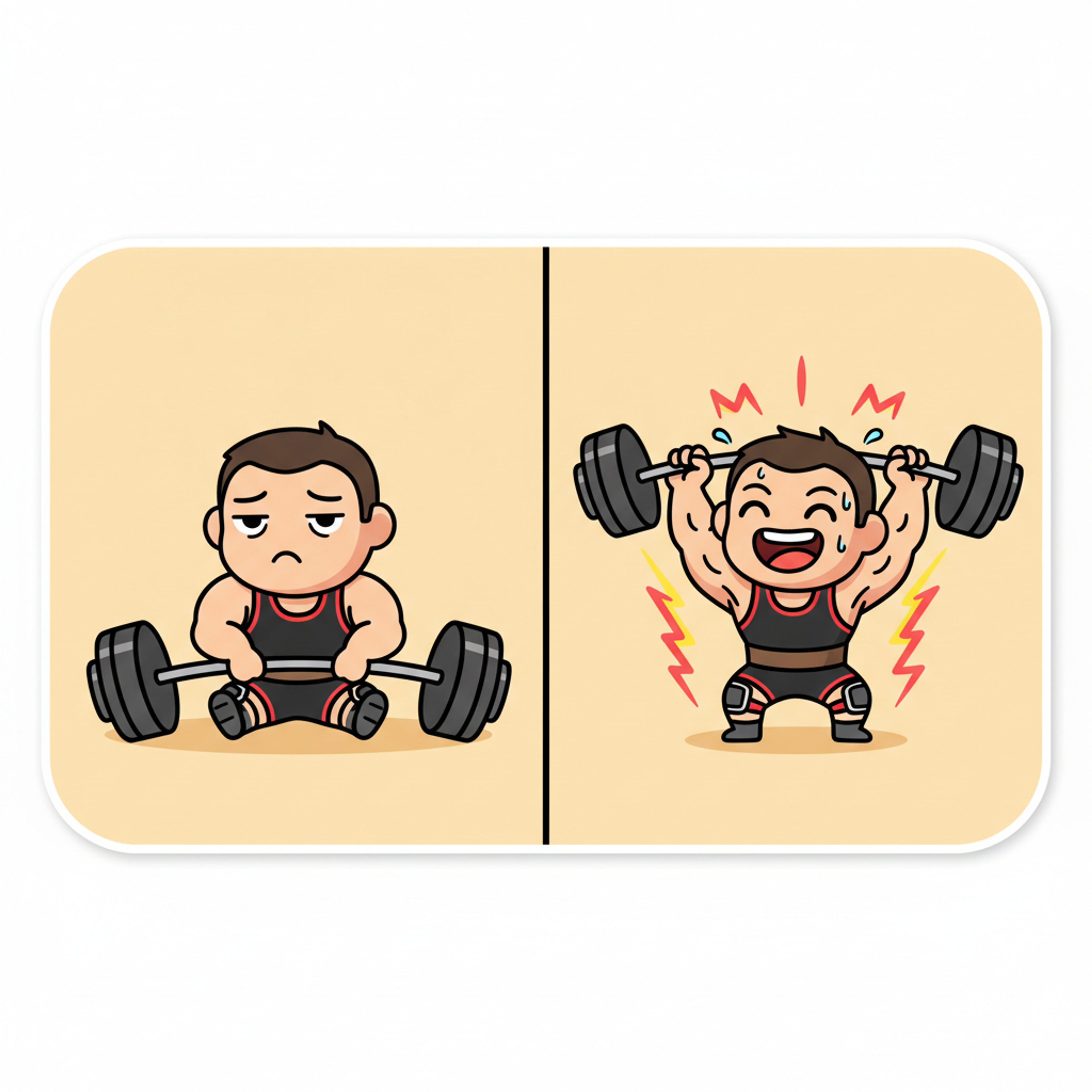
Every experienced lifter has been here. The alarm goes off. The gym is waiting. And you genuinely do not want to go.
The standard advice — "just push through," "find your why," "visualize your goals" — is motivational poster content. It does not address why motivation fails or what to replace it with.
Why Motivation Fails
Motivation is an emotional state. Emotional states are unreliable. They are influenced by sleep quality, stress, hormonal cycles, social comparison, life events, weather, and a hundred other variables you do not control.
Building a training practice on the foundation of motivation is building on sand. The lifters who train consistently for years are not consistently motivated. They have removed the decision.
The problem is not lacking motivation. The problem is requiring motivation.
The Systems Answer
Behavioral consistency does not come from motivation. It comes from identity and habit.
Identity: "I am someone who trains." Not "I want to be fit." Not "I am trying to get in shape." The distinction is significant. Identity-based behavior is stable under adverse conditions in a way that goal-based behavior is not.
Habit: Reduce the decision surface. Same time, same days, same gym bag packed the night before. When the habit is entrenched, skipping requires a decision. Going does not.
What to Do on Low-Motivation Days
Show up and give yourself permission to do less. The most important thing is walking through the door. Commit only to the warm-up. Once you are there, moving, blood flowing, most people find they want to continue.
Lower the stakes. A sub-optimal training session — reduced volume, lighter loads, fewer exercises — is vastly superior to no session. Progress is the accumulation of many adequate sessions, not a handful of exceptional ones.
Distinguish between low motivation and genuine recovery signals. Fatigue, soreness, disrupted sleep, and elevated resting heart rate are signals worth listening to. Sometimes "I don't feel like training" is legitimate biological feedback. Sometimes it is just inertia. Learning to tell the difference takes experience.
Structural Solutions
If low motivation is chronic rather than occasional, the program may be the problem:
- Too much volume. Accumulated fatigue blunts motivation. If you dread every session, you may be doing more than you can recover from.
- No variety. Doing the exact same workout for months destroys interest. Variation in exercises, rep ranges, and training modalities matters.
- No short-term goals. Training without a target (a meet, a PR attempt, a specific weight class) reduces the sense of purpose. Enter a competition or set a measurable goal with a date.
- Social isolation. Training with a partner or in a community significantly improves consistency across populations. Find a training partner or join a club.
Motivation is a passenger. Systems, identity, and environment are the driver. Build the structure, and motivation will follow — or become irrelevant.
About Rasmus
Powerlifter and coach with more than 7 years in the game.
Related Articles
Should You Do Speed Work
Speed work sounds like it's for athletes. You are a powerlifter. You lift heavy things slowly.

Should You Use a Belt in Training
The belt debate produces more heat than light. One camp says never use a belt — you need to build raw core strength first. The other says always wear a belt — protect your spine at all costs.
Does Arm Training Actually Matter for Your Bench
The conventional wisdom in powerlifting: don't bother with curls, your arms get enough work from the big lifts. The conventional wisdom in bodybuilding: arms need direct work to grow. Both camps are p