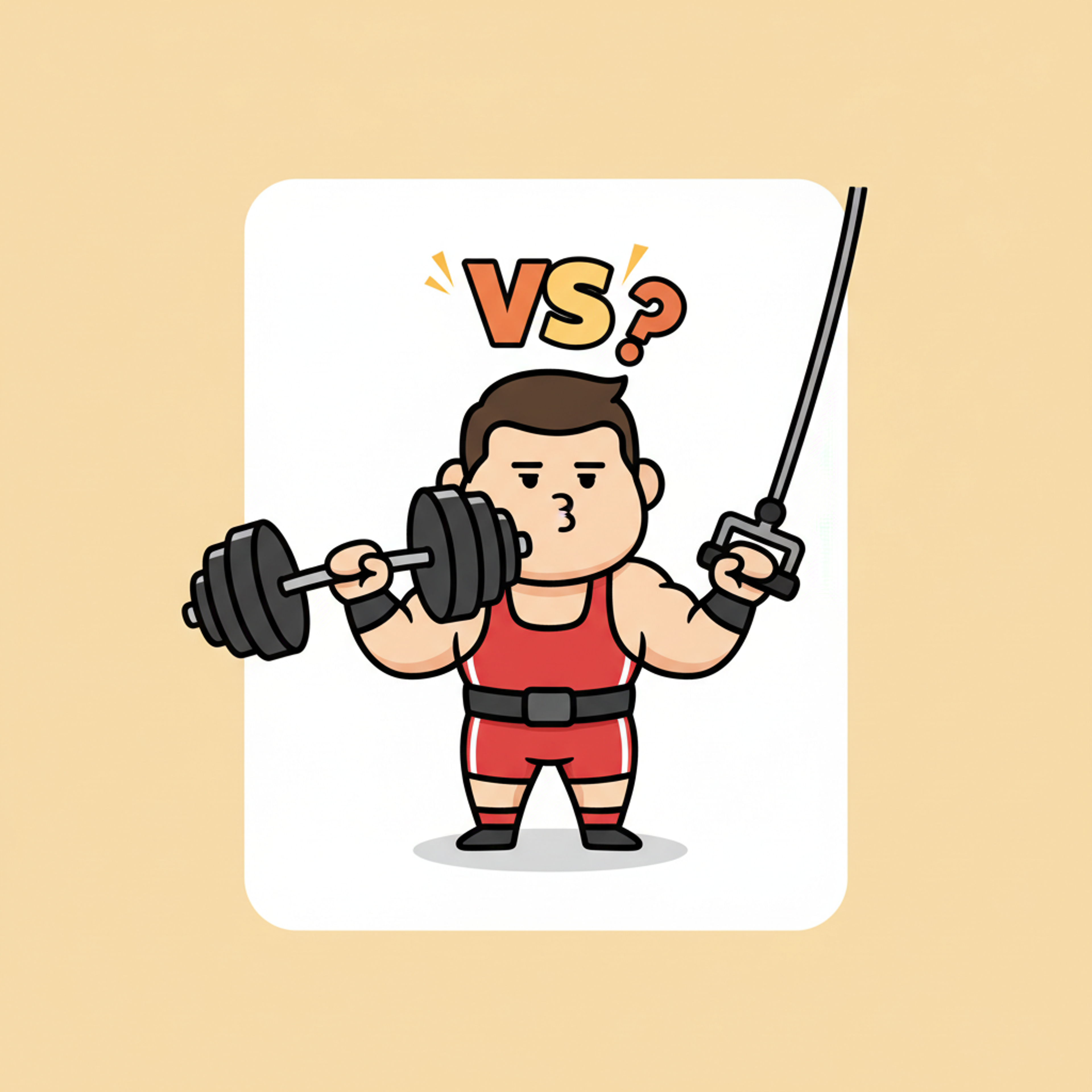
This is not a debate. The answer is both, used strategically.
Anyone still arguing that free weights are inherently superior to machines — or that machines are cheating — is fighting a battle from the 1980s that the research has long since settled.
What Free Weights Do Well
Proprioception and stability demand. A barbell squat requires you to balance the load, control the bar path, and stabilize joints that a machine stabilizes for you. This trains coordination and the stabilizing musculature.
Specificity. If you compete in powerlifting, you must train the barbell movements. The squat rack is non-negotiable.
Force angle. Free weights provide a gravitational load vector — straight down. This is ideal for movements where the target muscle's line of pull aligns with gravity (squats, deadlifts, overhead press, bench press).
Progressive overload simplicity. You add plates. The movement stays the same. This is clean and easy to track.
What Machines Do Well
Isolation. Machines constrain the movement to target a specific muscle. When the stabilizers cannot give out, you can take the target muscle to true mechanical failure. This is the primary driver of hypertrophy in accessory work.
Low systemic fatigue. A leg press does not load your spine axially. A chest-supported row does not fatigue your lower back. Lower fatigue cost means more volume capacity — you can do more sets before recovery becomes the limiting factor.
Safety at failure. You can take a leg extension or lat pulldown to failure alone without risk of dropping a bar on yourself. This allows higher intensities in accessories without a spotter.
Consistent resistance curve. Cable and machine resistance can be engineered to match the strength curve of the muscle. A cable fly provides more tension in the stretched position than a dumbbell fly — mechanically superior for chest hypertrophy specifically.
The Framework
Use free weights for:
- Competition movements and their close variations
- Movements where balance and coordination are part of the training goal
- Primary compound movements in your strength training
Use machines for:
- Accessory and isolation work targeting specific muscles
- High-rep hypertrophy work where fatigue management matters
- Any movement where free weight failure would be dangerous without a spotter
Practical example for a lifter focused on strength with hypertrophy secondary:
Role | Tool
Squat | Barbell back squat
Quad accessory | Leg press or hack squat
Hamstring | Barbell RDL + seated leg curl
Back | Barbell row + chest-supported machine row
Chest | Barbell bench press + cable fly
Shoulders | Dumbbell press + cable lateral raise
The goal is not purity. The goal is results. Use whatever gets the target muscle trained effectively with the minimum fatigue cost.
About Rasmus
Powerlifter and coach with more than 7 years in the game.
Related Articles
Should You Do Speed Work
Speed work sounds like it's for athletes. You are a powerlifter. You lift heavy things slowly.
Should You Use a Belt in Training
The belt debate produces more heat than light. One camp says never use a belt — you need to build raw core strength first. The other says always wear a belt — protect your spine at all costs.
Does Arm Training Actually Matter for Your Bench
The conventional wisdom in powerlifting: don't bother with curls, your arms get enough work from the big lifts. The conventional wisdom in bodybuilding: arms need direct work to grow. Both camps are p